Data Solutions
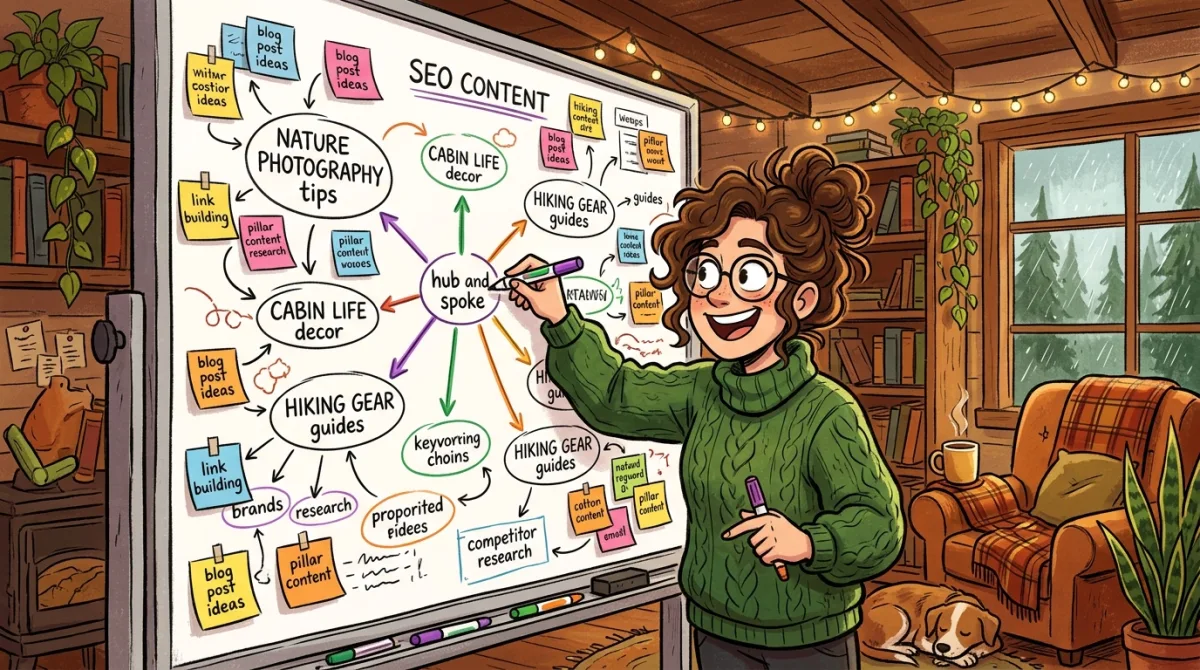
An SEO strategy document is a single source of truth that defines what your brand is, who you're targeting, what queries you're going after, how your site is structured, and how you'll create and distribute content to rank - and get cited by AI systems. Without one, you're guessing. With one, every article you publish compounds.
Most SEO advice gives you tactics. Keyword research. Backlink outreach. Meta tag checklists. But no one hands you the architecture - the strategy document that ties all of it together before you write a word.
This is that document. Not explained in abstract - we'll show you exactly how Full Stack Data Solutions built theirs, using the framework from Will Cannon's SEO Playbook at iamwillcannon.com/free-resources.
Your job isn't another article. It's an engine. Here's how to build yours.
Part A: Brand, Architecture, and Technical Foundation
1. Entity Definition, What Google Must Know About Your Brand
Google doesn't just read your pages. It builds a model of what you are. If that model is fuzzy, your rankings are inconsistent. If it's sharp, Google surfaces you for everything in your territory.
Entity definition is the process of telling Google exactly what your brand does, who it serves, and why it matters, with enough consistency across your site that Google can't misread it.
For Full Stack Data Solutions, that definition is:
Full Stack Data Solutions builds organic traffic systems for e-commerce brands, using SEO research, content architecture, and an AI-assisted production pipeline.
Every page on the FSDS site reinforces this. The homepage states it. The About page expands it. Every pillar page connects to one of its core terms: e-commerce SEO, content architecture, AI-assisted production.
That sentence used to say something else, and this article is the reason I noticed. Until September 2026 it read "helps tech workers and solo founders build profitable SaaS businesses using AI, GraphQL, and modern automation stacks." That was true when this was published in June. By September the homepage, the About page and the services page had all moved to e-commerce SEO, and this page had not, which made it the loudest inconsistent entity signal on the site. On the page whose own first section is about entity consistency.
Worth stating plainly because it is the most common way this fails: nobody rewrites their entity definition on purpose. The business moves and the strategy document quietly stops describing it. If you have one of these documents, the date on it is the first thing to check.
How to define your entity
- Write one sentence that states what you do, who you serve, and the outcome you deliver. No jargon.
- Make sure that sentence, or a close variation, appears on your homepage, your About page, and each pillar page.
- Use the same terms consistently. If you call it "solo founding" on one page and "indie hacking" on another, Google builds a weaker entity model.
Consistency is the variable. One clean sentence, everywhere.
2. Target Audience Search Intent: Know What Your People Are Actually Typing
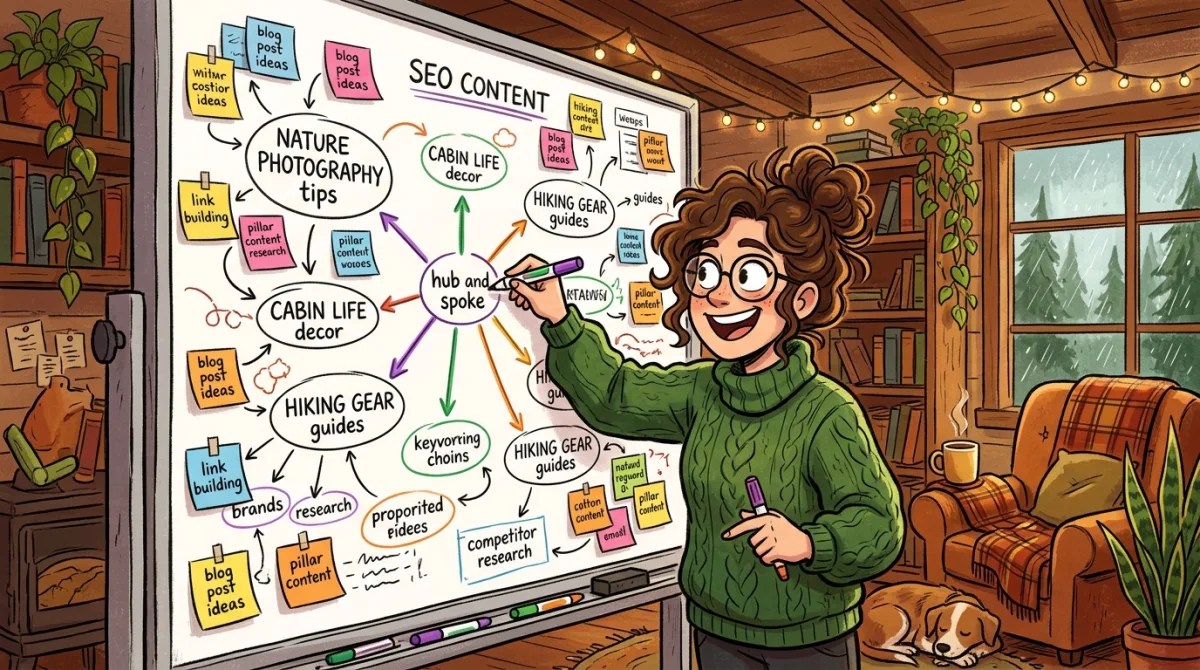
Your audience's search intent isn't what you think they care about, it's what they type when they're frustrated, curious, or actively solving a problem.
FSDS is built for people who sell online and are paying for every visitor. These people search for:
- Shopify SEO audit / what to check on my store
- Shopify SEO services / what does an SEO agency actually do
- Why my collection pages don't rank
- How to get organic traffic without ads
- Whether AI search is going to matter
The second one matters more than its search volume suggests. Someone typing "shopify seo services" has usually already been burned by a retainer, and they are not looking for education. They are looking for a way to tell providers apart. Content that meets that search with a straight answer, including what you would not do for them, converts better than another explainer.
How to map your audience's search intent
- Think about the three moments when your audience reaches for Google: when they're curious, when they're stuck, and when they're scared.
- Write 5-7 queries for each moment.
- Check which queries Google clusters together, tools like Ahrefs Keywords Explorer show related queries ranked for the same URL. Don't create multiple articles for queries in the same cluster.
- Map each cluster to a content type: TOFU (educational), MOFU (tool comparison), BOFU (comparison/decision).
3. Primary Keyword Clusters: Query Sets, Not Individual Keywords
Old SEO: one article per keyword.
Modern SEO: one article per query set, the cluster of related queries Google serves the same URL for.
FSDS is built around three topic hubs, each anchored by a pillar page:
E-commerce SEO Hub
Pillar: Shopify SEO Services: What's Actually Included
Query set: shopify seo services, shopify seo agency, ecommerce seo services, what does shopify seo include, shopify seo cost
Supported by Shopify SEO Audit: What to Check First, which takes the adjacent audit intent rather than competing for the same set.
AI Search / GEO Hub
Pillar: Generative Engine Optimization: What the Data Shows
Query set: generative engine optimization, ai search optimization, llm seo, how to rank in chatgpt, ai seo
Supported by Markdown Twins, which covers the implementation half.
Evidence Hub
Pillar: Role Players Guild: Zero to 650 Daily Visits
Query set: seo case study, how long does seo take, organic traffic growth case study, seo results timeline
Three hubs, not four. The fourth used to be a GraphQL hub, and cutting it was the harder decision of the two described in this article. The reasoning is in the section below.
The rule is simple: if Google shows the same articles for two queries, they belong on one URL. You don't get extra credit for creating separate pages, you dilute your own authority.
How to find your query sets: Ahrefs Keywords Explorer -> search your main topic -> click "Clusters by Parent Topic." One URL per cluster.
3a. What happened when I audited this against real data
This section did not exist in the June version. It exists because three months later I checked the plan against Search Console instead of against my own memory, and two of the answers were not what I expected.
The hub I had built the most content around was the one nobody clicked. The GraphQL hub held 22 articles, comfortably the largest section of the library. Over six months it produced 4.6 percent of the site's clicks. A single article about AI-assisted development produced 78 percent. I had been planning around GraphQL for months, and the data saying otherwise had been sitting in Search Console the whole time.
Note the specific shape of that failure, because it is not the obvious one. Those 22 articles were not invisible. They earned impressions. They just earned impressions from people who did not click, which looks like partial success on a dashboard and is worth close to nothing.
And the consolidation I had planned would have made things worse. The strategy called for merging a CI/CD series into a single pillar and redirecting the old URLs. Checking first showed that two of those articles were the site's second and fourth most-clicked pages, carrying 28 percent of its impressions between them. Redirecting them into a brand-new URL with no history would have gambled a quarter of the site's visibility to tidy up an outline. That consolidation was cancelled.
Two rules came out of this, and they are the ones I would hand someone before any of the framework above:
- Rank your hubs by clicks before you rank them by how much you have written. Shelf space is not readership, and the section you have invested most in is the one you are least able to judge.
- Never redirect a page you have not looked up. A consolidation plan drawn on a whiteboard cannot see which URLs are load-bearing, and redirects are the one SEO decision that is expensive to reverse.
The general version: a strategy document is a hypothesis. It is worth exactly as much as the last time you tested it against data, which is why the update calendar in section 8 is not administrative housekeeping.
Does the framework work? The most direct evidence I have is a reference site built on this architecture that went from an empty index to 658 unique organic visitors a day in nine weeks, with no ads and no social distribution, where the two highest-traffic URLs were both category hubs rather than individual articles. It then lost most of its Google traffic to a spam action, because I kept publishing past the rate the site could absorb. Both halves are in the full case study, and the second half is the more useful one: this framework tells you what to publish, and it does not tell you how fast.
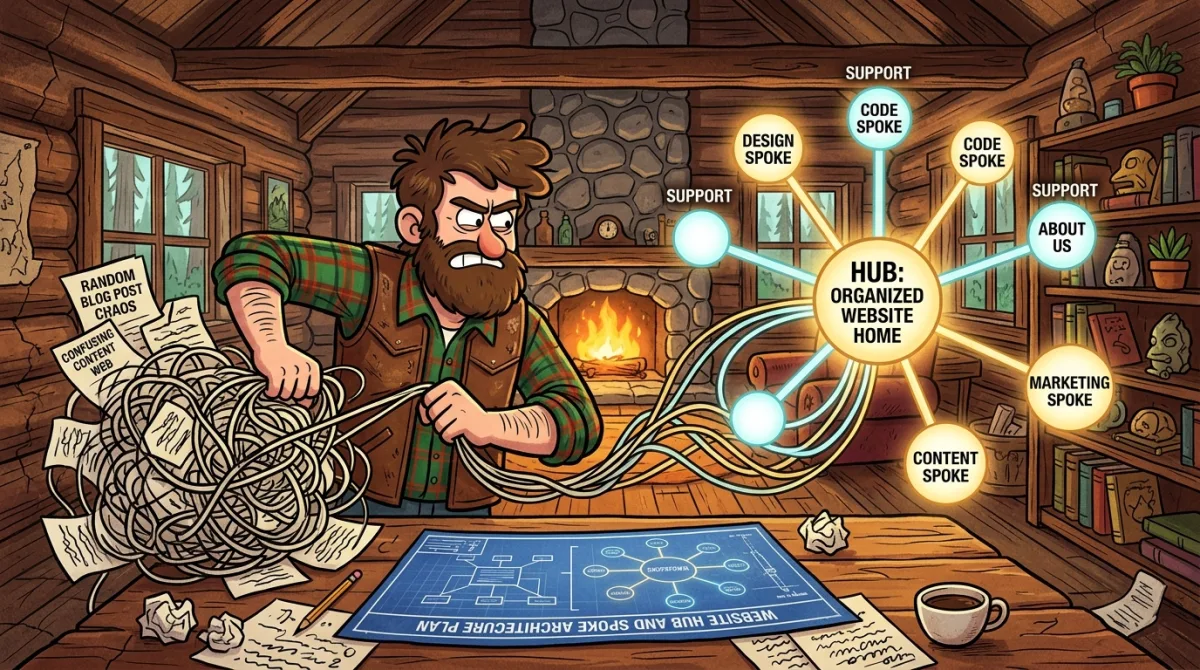
4. Site Architecture and URL Structure: Build the Hub-and-Spoke
Google rewards topical authority. You build topical authority by creating complete coverage of a topic, not by writing isolated articles.
The hub-and-spoke model:
Pillar Page (Hub)
├── Cluster Page: Specific Subtopic
├── Cluster Page: Tool/Tutorial
├── Cluster Page: Comparison
└── Support: FAQs, Checklists, Quick Guides
Every cluster page links to its pillar. Every pillar links back to all clusters. This closed loop signals to Google: this site owns this topic.
URL Rules
| Bad | Good |
|---|---|
fsds.com/post/12345/how-to-build-a-saas | fsds.com/solo-saas-guide |
Short, descriptive, keyword-focused. Every URL tells Google what the page covers. No dates. No post numbers. No category folders that add nothing.
5. Technical SEO: The Performance Foundation Nobody Fixes
Rankings are a function of relevance AND technical performance. You can have the best content on the internet and still lose to a faster, cleaner page.
Core Web Vitals
Your LCP (Largest Contentful Paint) target is 2.5 seconds. The FSDS approach:
- Do NOT lazy-load the LCP image. Deliver it with
fetchpriority=highand a<link rel="preload">tag. - Defer non-critical JavaScript. Your LCP image shouldn't wait for scripts to load.
- Use server-rendered HTML for critical copy. This matters for AI citations too, LLMs struggle to parse client-side rendered content.
Image Optimization
Every image under 100KB. No exceptions. Use TinyPNG or Squoosh before uploading.
Alt text that includes the target keyword naturally:
- Bad:
alt="screenshot-1.png" - Good:
alt="Solo founder SaaS dashboard showing MRR and churn metrics"
Meta Titles and Descriptions
Meta titles describe, they don't sell. Put the CTA in the description.
- Title:
"23 AI Tools for Solo Developers to Ship Faster in 2025", clear, specific, keyword-forward - Description:
"Looking for AI tools that actually work for solo devs? Here are 23 tested tools that help indie founders automate, build, and ship, without a team."
Set og:title intentionally. Google sometimes pulls it instead of your title tag.
Structured Data
Use JSON-LD for entity information on pillar pages. Add FAQ schema to every article's mini-FAQ section, this increases AIO eligibility significantly.
6. Content Structure for Semantic Dominance and AI Citations
Here's the uncomfortable truth: if your content isn't structured for AI systems, you don't exist in AI search.
Google's AI Overviews. ChatGPT. Claude. Perplexity. They all pull from the same underlying principle: well-structured, clearly attributed, question-answering content gets cited. Rambling paragraphs don't.
Kevin Indig's research on 546,000 AI Overviews found that content using a specific heading hierarchy was cited 40% more often. FSDS implements it on every article:
H1: Article title
H2: Direct Answer (2-3 sentences answering the main query immediately)
H2: What is [main topic]?
H2: Most relevant question from query set
H2: Follow-up questions based on query fan-out
...
H2: FAQs
  H3: FAQ question 1
  H3: FAQ question 2
  H3: FAQ question 3
H2: Conclusion
AIO-Ready Content Module, Add to Every Article
- Direct Answer block at the top: 2-3 sentences that answer the primary query immediately
- Evidence block: 1-3 citations to third-party studies or industry reports
- Mini-FAQ section: 3 Q&As with FAQ schema markup
- "Last Updated" timestamp near the top
- Sources footer: 3 named sources
Front-loading evidence
Marie Haynes' research shows "fact-checkable snippets" dramatically increase AI citation rates. The formula:
- First paragraph: Direct answer with concrete data
- Second paragraph: Attribution to an authoritative source
- Third paragraph: Supporting context
Question-based headlines
Google converts your headlines to questions internally. Beat it to the punch:
- Instead of: "Solo Founder Marketing Best Practices"
- Write: "What Are the Best Marketing Strategies for Solo Founders?"
Part B: Content Strategy, Funnels, and the AI Era
7. Content Types by Funnel Stage: TOFU, MOFU, BOFU
Not every article serves the same purpose. Your content map assigns every piece a role in the funnel.
TOFU, Top of Funnel (Informational)
Goal: capture people who don't know you yet and are educating themselves.
Process:
- Find the best-performing article for your main query in Ahrefs Keywords Explorer
- Click keyword count -> filter Position 15 -> identify the full related query set
- Analyze the top 10 results for search intent
- Write one comprehensive guide covering the entire query set
FSDS TOFU examples:
- "How to Build a SaaS as a Solo Developer" (pillar)
- "What Are the Best AI Tools for Indie Hackers?" (cluster)
- "How Do Tech Layoffs Actually Work?" (career escape hub)
MOFU, Middle of Funnel (Tool Roundups, Comparisons)
Goal: capture people who are evaluating options.
The listicle formula:
- Hook with compelling number + clear category
- Brief intro on why these tools matter
- Each tool: what it does, key features, pricing, pros/cons
- Include FSDS offerings naturally when relevant
- Clear CTA
FSDS MOFU examples:
- "25 Best AI Tools for Indie Hackers and Solo Founders"
- "Best Automation Stacks for Solo SaaS Founders (Ranked)"
- "21 GraphQL Tools Every Developer Should Know"
BOFU, Bottom of Funnel (Comparisons, Alternatives, Brand)
Goal: capture people close to a decision.
Three BOFU content types:
Comparison/Vs: "GraphQL vs REST: Which Should You Use for Your SaaS?"
Alternatives: "15 Best Alternatives to [Major Tool] for Solo Developers"
Brand vs Competitor: "[Competitor] Pricing 2025: Is It Worth It for Solo Founders?"
People researching competitor pricing are close to a decision. BOFU content drives the highest-converting organic traffic. FSDS prioritizes it in the content calendar.
8. Content Update Calendar: The 3-Dimensional Update Framework
Publishing is not a one-time event. The difference between sites that plateau and sites that compound is a systematic update process.
Update frequency by content type
| Content Type | Update Frequency |
|---|---|
| BOFU (comparisons, alternatives) | Every 3 months |
| MOFU (tool lists, how-tos) | Every 6 months |
| TOFU (educational guides) | Every 12 months |
Dimension 1: Missing or Outdated Facts
Use this ChatGPT prompt before updating any article:
"I'm updating an article about [TOPIC] originally published in [DATE]. Identify what factual info, statistics, or industry developments might be outdated. Focus on: key stats that change annually, software features/pricing, industry trends, regulatory changes, new research."
Dimension 2: Missing Entities and Keywords
- Ahrefs: Keywords Explorer -> SERP Overview -> find top-ranking article with most keywords -> filter Position 1-15 -> find keywords you haven't included
- Google Search Console: Performance -> Pages -> select article -> filter Queries for Position 11-50 -> identify queries not mentioned in your content
- Surfer SEO: Content Editor -> Terms section -> find missing entities
Dimension 3: Missing or Outdated Topics
Use this ChatGPT prompt:
"I have an article about [MAIN TOPIC] covering these sections: [LIST H2 HEADINGS]. Identify important subtopics I'm missing. Review SERP competitors, identify related questions users ask, suggest emerging trends, recommend case studies or examples to add."
Updates that address all three dimensions can move a page from position 12 to position 4 without a single new backlink.
9. Internal Linking Architecture: Build the Authority Loop
Internal links do two things: they send PageRank from established pages to new ones, and they signal to Google which pages are most important in a topic cluster.
Hub-and-spoke linking rules
- Every cluster page links to its pillar page
- Every pillar page links to all cluster pages
- Every new article includes 2-4 contextual internal links
- Anchor text is always descriptive (never "click here")
- Top pages get "Related reading" boxes pushing authority toward BOFU pages
The FSDS Internal Linking Sprint (1-2 weeks)
- Export all URLs and target topics
- For each hub, confirm pillar cluster links exist (2-4 per page)
- Fix generic anchor text to be descriptive
- Add "Related reading" boxes in the top 30 URLs pointing toward BOFU pages
- Re-crawl in Ahrefs or Screaming Frog to verify
One sprint. Then make it part of the publishing checklist for every new article.
10. Off-Page Strategy: The Seed Method
FSDS link building focuses on three page types:
- Homepage, for domain authority
- Topic Hub Pillar Articles, for topical authority
- BOFU Content, for commercial keyword rankings
Community Engagement (Relationship First)
Build relationships before you ask for links. Communities relevant to FSDS:
- Indie Hackers (forum and newsletter)
- r/SaaS, r/IndieHackers, r/webdev, r/entrepreneur
- Top of the Funnel Slack
- Twitter/X #buildinpublic
Join. Add value. The links follow.
Link Insertions Over Guest Posts
Link insertions, adding your link to existing articles on another site, often outperform guest posts. They're faster, have higher response rates, and the page already ranks.
FSDS reciprocation policy: when someone links to FSDS, link back from relevant content, share their article in the newsletter, and feature them in future roundups.
The 3-Sentence Rule for HARO and Press Mentions
- Sentence 1: Direct answer with a specific stat or example
- Sentence 2: Your unique angle or contrarian insight
- Sentence 3: Your credentials (brief)
Respond within 2 hours. Most journalists pick from the first 10 responses. Include one stat they can cite. Never pitch, provide value.
Reddit as an AI Signal
AI systems increasingly cite Reddit and forum discussions as "real user opinions." Active participation in r/SaaS, r/IndieHackers, and r/entrepreneur, with helpful responses that mention FSDS when relevant, builds citations in AI search results.
11. Content Funnels: How Traffic Becomes Revenue
Publishing articles without funnels is a branding exercise. You want a pipeline.
Blog Funnel (BOFU -> Trial/Newsletter)
- Stage 1: High-intent listicle and comparison content attracts evaluating visitors
- Stage 2: Strategic CTAs
- In-content: "Download the Solo Founder Toolkit" / "Join the newsletter for weekly indie hacker insights"
- End-of-article: "Ready to build your own SaaS? Start here ->"
- Exit-intent: "Before you go, grab the free [lead magnet]"
- Stage 3: Email nurture -> conversion
Newsletter Funnel (TOFU -> Nurture -> Customer)
Articles -> Lead Magnet CTA -> Beehiiv opt-in -> Mautic nurture sequence
Newsletter value sequence:
- Industry insights and trends for solo founders
- How-to tutorials and templates
- Case studies and success stories
- Product/tool updates (10% promotional maximum)
12. Adapting for the AI Era
Search is changing. The user behavior shift: instead of researching across multiple sources, people get one comprehensive answer from an AI system. Your goal is to be that answer.
Google AI Overviews. ChatGPT. Claude. Perplexity. They all cite from the same pool: authoritative, consistently structured, frequently updated content from brands with clear entity definitions.
The 3-Pillar AI Approach for FSDS
- Entity Ownership: Become the definitive source for "e-commerce SEO," "Shopify SEO services," and "generative engine optimization", not one of many sources, but the source.
- Citation Optimization: Structure all content using the AIO-ready module: Direct Answer -> Evidence -> FAQ -> Sources.
- Multi-Platform Presence: Ensure FSDS appears across all information sources AI systems pull from, Reddit, LinkedIn, X, Indie Hackers, podcast interviews, industry publications.
AI Era Metrics to Track
Traditional (still important): organic traffic, keyword rankings, conversion rate, backlinks.
New and increasingly important:
- Brand mentions in Google AI Overviews
- LLM citation tracking (how often FSDS is cited in ChatGPT, Claude, Perplexity)
- Featured snippet ownership for target queries
- Entity association strength
Tracking tools: ZipTie, Profound, or Peec AI for AIO tracking; SE Ranking AIO Tracker; Google Search Console for featured snippets.
13. Tools Stack
| Purpose | Tool |
|---|---|
| Keyword research and competitor analysis | Ahrefs |
| Content optimization and briefs | Surfer SEO |
| Search performance and indexing | Google Search Console |
| Analytics | Google Analytics |
| Content planning | Notion |
| Writing | Google Docs + Surfer integration |
| AI Overview tracking | ZipTie / Peec AI |
| Email marketing | Beehiiv (opt-in) + Mautic (nurture) |
14. Content Calendar Rhythm
The FSDS weekly publishing rhythm:
| Day | Activity |
|---|---|
| Monday | Draft week's article + queue social posts + trending research |
| Tuesday | LinkedIn + X posts live |
| Wednesday | LinkedIn + X posts live |
| Thursday | Article publishes -> Reddit + Medium repost auto-triggers |
| Friday | LinkedIn + X posts live |
| Saturday | LinkedIn + X posts live |
| Sunday | Weekly newsletter sends (Beehiiv) |
One article per week. Five social posts. One newsletter. That's 52 articles, 260 social posts, and 52 newsletters per year, from one engine running one hub at a time.
FAQs
What is an SEO strategy document?
An SEO strategy document is a single reference that defines your entity, target audience search intent, keyword clusters, site architecture, technical requirements, content structure, and distribution plan. It's the strategic layer before any individual article gets written, the document that makes every piece of content a deliberate move rather than a guess.
How long does it take to see results from an SEO strategy?
Most SEO timelines are 3-6 months before meaningful traffic movement, 6-12 months before strong rankings across a topic cluster. The entities and technical foundation you set up in the first 30 days do the compounding work over the following year. The sites that win are the ones that don't quit at month four when rankings are still building.
Do I need to follow every section of the strategy document?
No. Start where the leverage is highest for your current stage. If you have no entity definition, start there. If you have content but no internal links, run the linking sprint. The strategy document is a reference system, so you build it in priority order rather than all at once.
How often should an SEO strategy document be updated?
Check it against Search Console every quarter, and rewrite the entity definition whenever the business changes what it sells. Both matter more than they sound. The June version of this document described a business that no longer existed by September, and its largest content hub turned out to be producing 4.6 percent of clicks while a single article outside it produced 78 percent.
Conclusion
Most founders skip the strategy document and jump straight to publishing. They end up with 20 articles about tangentially related topics, no clear topical authority, no funnel, and no compounding.
Build the document first. Define your entity. Map your query sets. Architect your hubs. Optimize for AI systems from day one. Then write.
The content won't feel faster in month one. It'll feel much faster in month six, when each article you publish lands in an established structure that Google already respects.
Then check it against data before you trust it. The version of this document I published in June was internally consistent, carefully argued, and wrong about which section of my own site was working. Three months of Search Console settled that in an afternoon.
Ready to build your content engine? Full Stack Data Solutions builds organic traffic systems for e-commerce brands. If you sell online and want traffic that keeps working after the ad spend stops, tell me what you sell.
Sources:
- Will Cannon, The SEO Playbook, iamwillcannon.com/free-resources
- Kevin Indig, AI Overview Citation Research (546,000 AIO analysis)
- Marie Haynes, Fact-Checkable Snippets and AI Citation Research